Nov 3 2026
Why Won’t My Thermostat Switch Between Heating and Cooling?
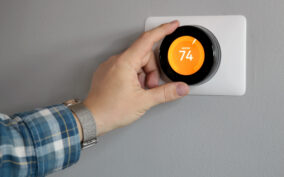
Midwest seasonal weather can be all over the place with hot days and cool nights a hallmark of autumn. Your home’s comfort depends on your thermostat keeping up with the changes that dictate whether your furnace or air conditioner should be running.
A thermostat that will not switch between heating and cooling usually points to one of a few causes:
- Incorrect mode or schedule settings
- A wiring or control circuit problem
- A sensor issue
- Equipment that is not responding to the thermostat’s signal.
Some fixes are simple, like adjusting a setting, while others need a trained technician to diagnose the control system and equipment. Our team at Van Drunen Heating & Air Conditioning has years of experience to help homeowners with issues.
Common Reasons Thermostats Fail to Switch Between Heating and Cooling
Cooling and heating do not always share the same thermostat pathway. Depending on your equipment, the thermostat sends distinct signals for the AC compressor, the furnace, the indoor fan, and, in some homes, a heat pump’s reversing valve. That means your AC can work all summer without ever proving the heating side of the system functions correctly.
A few of the most frequent culprits include:
- An incorrect mode setting, where the system is still set to Cool, Auto, or Off instead of Heat.
- A programmed schedule overriding the temperature you have selected.
- Weak or dead batteries in a battery-powered thermostat.
- A loose or damaged wire on the heating side of the control circuit.
- A thermostat that is not properly configured for your equipment type.
Because heating and cooling often rely on different terminals and control logic, a thermostat can operate one mode perfectly while struggling with the other.
How Incorrect Settings or Wiring Issues Affect System Operation
When a thermostat setting is wrong, the fix can be as easy as flipping the mode and confirming the target temperature sits above the current room temperature. Homeowners should also check for an unexpected scheduled setback that quietly overrides the temperature they want.
Wiring problems are a different story. If a connection on the heating side has come loose, corroded, or was never properly terminated, the thermostat may call for heat without the furnace ever receiving that signal. This is not something to troubleshoot by opening panels or moving wires yourself. Low-voltage control wiring connects directly to your HVAC equipment, and an incorrect connection can prevent the system from operating safely or at all.
Configuration mismatches cause similar symptoms. A thermostat that has been replaced, reset, or updated needs to know exactly what kind of equipment it is controlling. Get that configuration wrong, and heating performance suffers even though cooling still runs fine.
How Switching Problems Impact Comfort and Efficiency
A thermostat that cannot properly transition between modes rarely fails quietly. Homeowners often notice rooms that never reach the set temperature, a system that runs constantly without catching up, or short cycling, where the unit turns on and off in rapid bursts. Each of these problems places extra strain on your furnace or AC, which can shorten its lifespan and drive up energy bills.
Inconsistent switching also affects daily comfort. A house that is warm downstairs and chilly upstairs, or a system that seems to fight itself between heating and cooling calls, makes it harder to keep your home at a steady temperature. Left unresolved, small thermostat issues tend to compound into larger, more expensive equipment problems over time.
When Thermostat Issues Require Professional HVAC Service
Some checks are safe for homeowners to handle:
- Confirming the mode setting
- Replacing batteries
- Checking the schedule
- Making sure vents and filters are clear.
If those steps do not resolve the issue, professional service is the next reasonable step.
- Signs it’s time to call a technician include:
- A system that repeatedly fails to start in one mode
- A thermostat that behaves inconsistently between heating and cooling
- Symptoms that began after a thermostat replacement or reset.
A qualified technician can confirm whether the thermostat, the control wiring, or the heating or cooling equipment itself is responsible, which helps avoid replacing a thermostat that was never the actual problem. Connect with the Van Drunen Heating & Air Conditioning team for an appointment.